EARTH,
LINKED
IN TIME.
715 images of our planet. Captured by a Raspberry Pi aboard the International Space Station — linked together through cryptographic hashes.
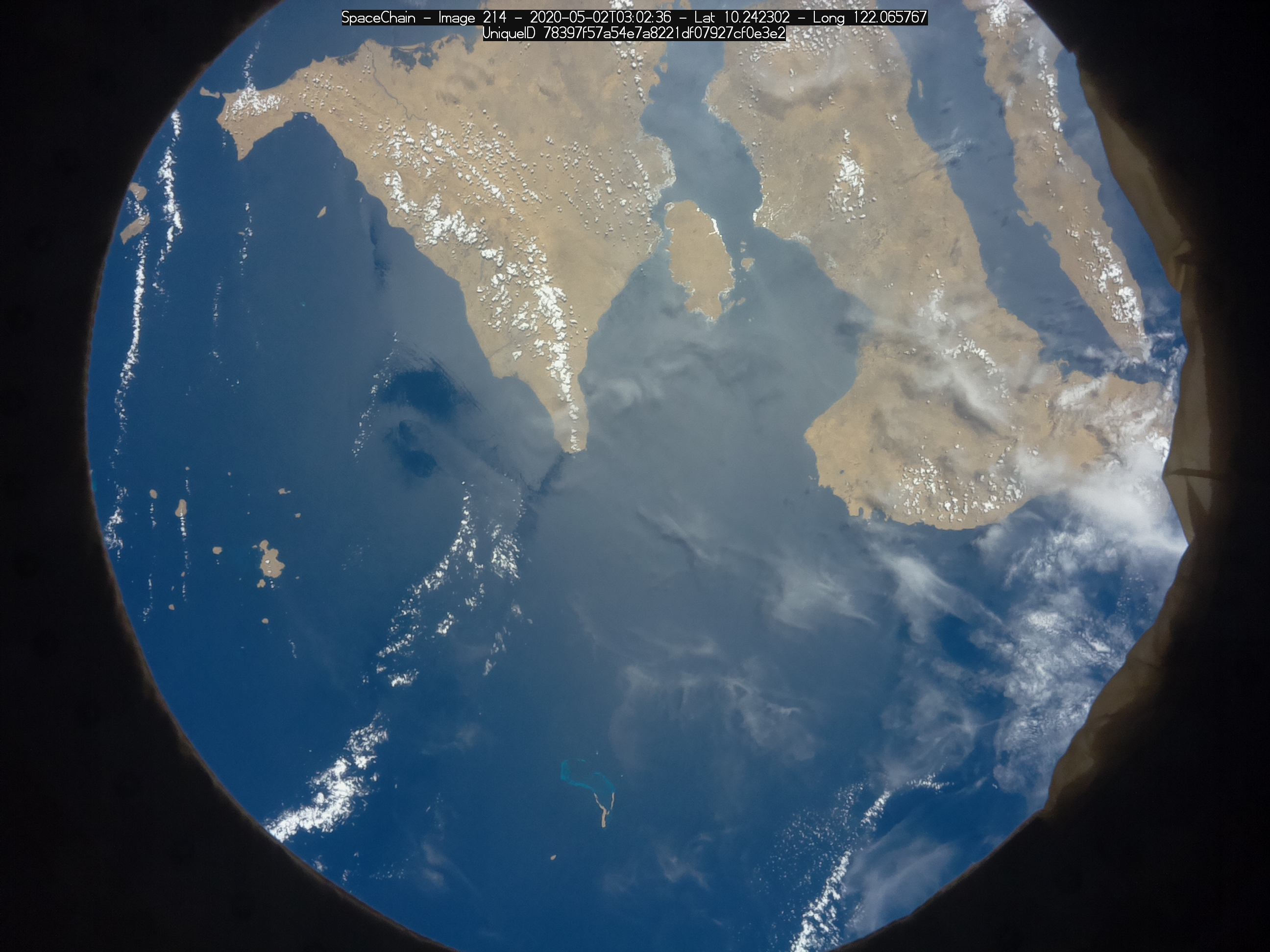
Image courtesy of ESA/Raspberry Pi Foundation
From darkness into daylight: two moments captured near the end of the experiment.
Follow the journey.
Each point marks the calculated ISS position when an image was captured. Select a point to explore the frame and its data.
Markers show the ISS position, not necessarily the centre of each image. Image data: SpaceChain experiment 2020. Map data: © OpenStreetMap contributors.
715 singular moments.
Search the original sequence by frame number, or explore individual moments from the three-hour experiment.
A classroom experiment.
An orbital perspective.
In the 2019/2020 European Astro Pi Challenge, students at Kollegium Kalksburg in Austria designed a Python experiment for a Raspberry Pi on the International Space Station. Their aim was to collect a photographic record of Earth while connecting each observation to the spacecraft's position and the moment of capture.
On 2 May 2020, the experiment recorded 715 consecutive images over nearly three hours. The resulting archive combines photographs, timestamps, coordinates and altitude data with a deliberately constructed chain of cryptographic hashes.
SpaceChain is presented here as a record of the students' work: an exploration of programming, Earth observation and data integrity, with the original sequence available to inspect.
Why spacetoken.at? The name reflects the team's original vision, described in its 2020 mission report. After linking the ISS images through cryptographic hashes and displaying their locations on a map, the team envisaged a further phase: creating “Space Tokens”, unique digital twins of the photographs represented as NFTs on a blockchain. That was a proposed future step, not part of the ISS experiment itself. Today, this website preserves and explains the original educational project without issuing or selling tokens. Read the original Mission Space Lab report (PDF) ↗
Data provided by the European Space Agency. ESA data terms and conditions ↗
European Astro Pi Challenge 2019/2020 ↗Every frame leaves
a fingerprint.
The images are linked by file hashes, not by transactions on a cryptocurrency blockchain. Here's what the original experiment recorded.
- 01
Capture a frame
The Raspberry Pi saves a JPEG and records its capture time, calculated ISS position and altitude.
- 02
Calculate its SHA-256
A SHA-256 digest acts as a fingerprint of the exact JPEG file. Changing even one byte changes the computed digest with overwhelming probability.
- 03
Link the next frame
The previous image's SHA-256 is written into the next JPEG's EXIF ImageDescription. A separate UniqueID is derived from capture data.
- 04
Check the evidence
Compare the recorded links with the experiment CSV, then calculate a JPEG's SHA-256 independently to verify the original file bytes.
The complete CSV contains 714 matching consecutive hash references. This establishes consistency between the recorded links; verifying the actual JPEG bytes is a separate check.
Try the local file verifier ↗Built by students.
Shared for learning.
The original SpaceChain experiment was developed by a student team at Kollegium Kalksburg, Austria, with Chris Baumann as mentor, as part of the European Astro Pi Challenge 2019/2020.
The students' work
Programming the image-capture experiment, recording mission data and designing the hash-linked image sequence.
Explore the Python source code ↗The recorded data
The experiment CSV contains 715 records, including image numbers, timestamps, ISS positions, heights and cryptographic hashes.
Browse the mission CSV ↗Credits & provenance
Mentor: Chris Baumann. Data provided by the European Space Agency. This independent educational presentation is not an official ESA website.
ESA data terms and conditions ↗Trust, but verify.
Verify an unmodified original JPEG locally in your browser. Your file is never uploaded.
Use an unchanged original JPEG. A hash mismatch may indicate a modified or re-encoded file.